

Meta Title: What Is a Web Scraping API? Complete Beginner’s Guide (2026)
Meta Description: Learn what a Web Scraping API is, how it works, its benefits, common use cases, and why developers use services like ScraperAPI to efficiently collect public web data.
What Is a Web Scraping API? A Complete Beginner’s Guide (2026)
The internet contains an enormous amount of publicly available information, from product prices and customer reviews to search engine results, business directories, and news articles. Every day, companies rely on this data to monitor competitors, improve marketing strategies, train AI models, conduct market research, and build innovative digital products.
However, collecting data manually is slow, repetitive, and nearly impossible at scale. That’s where web scraping comes in.
Modern websites are also more complex than ever. Many use JavaScript to load content dynamically and employ anti-bot protections such as IP blocking, CAPTCHAs, browser fingerprinting, and rate limiting to prevent automated access. Building a reliable scraping system from scratch often requires significant engineering effort, ongoing maintenance, and a large proxy infrastructure.
A Web Scraping API solves these challenges by providing developers with a simple interface for collecting public web data. Instead of worrying about proxies, browser automation, or CAPTCHA-solving services, developers can send requests to a single API while the platform handles the technical complexity behind the scenes.
In this beginner-friendly guide, you’ll learn what a Web Scraping API is, how it works, where it’s used, and why businesses increasingly rely on managed scraping solutions to collect public data efficiently.
What Is Web Scraping?
Web scraping is the process of automatically extracting publicly available information from websites. Instead of manually copying data page by page, software can retrieve the information much faster and organize it into a structured format for analysis or integration into other systems.
Businesses across many industries depend on web scraping to stay competitive. For example, an online retailer may monitor competitors’ prices several times a day, while an SEO agency may collect search engine rankings to track keyword performance. Researchers, analysts, and AI developers also use web scraping to gather large datasets that would otherwise take countless hours to collect manually.
Some of the most common data collected through web scraping includes:
- Product prices and availability
- Customer reviews and ratings
- Search engine results (SERPs)
- News articles
- Real estate listings
- Business directories
- Job postings
- Public financial information
Although the concept sounds straightforward, modern websites often include sophisticated technologies designed to limit automated traffic. This is one of the main reasons developers turn to specialized scraping solutions instead of building everything from scratch.
What Is an API?
Before understanding a Web Scraping API, it’s helpful to know what an API actually is.
An Application Programming Interface (API) is a set of rules that allows two software applications to communicate with each other. Rather than interacting with a website through a browser like a human user, developers can send requests directly to an API and receive structured responses that their applications can process automatically.
APIs power many of the digital services we use every day. For example:
- A weather app retrieves forecasts through a weather API.
- A payment gateway processes transactions through a payment API.
- A mapping application displays locations using a maps API.
- Social media platforms allow integrations through their APIs.
The main advantage of APIs is simplicity. Instead of building complex systems yourself, you can access specialized services through standardized requests and responses.
The same principle applies to web scraping.
What Is a Web Scraping API?
A Web Scraping API is a service that enables developers to extract publicly available information from websites through simple API requests while the provider manages the underlying scraping infrastructure.
Instead of purchasing proxy servers, configuring browser automation tools, solving CAPTCHAs, handling retries, and maintaining anti-blocking systems, developers simply submit the target URL. The API then performs the data collection process and returns the requested content.
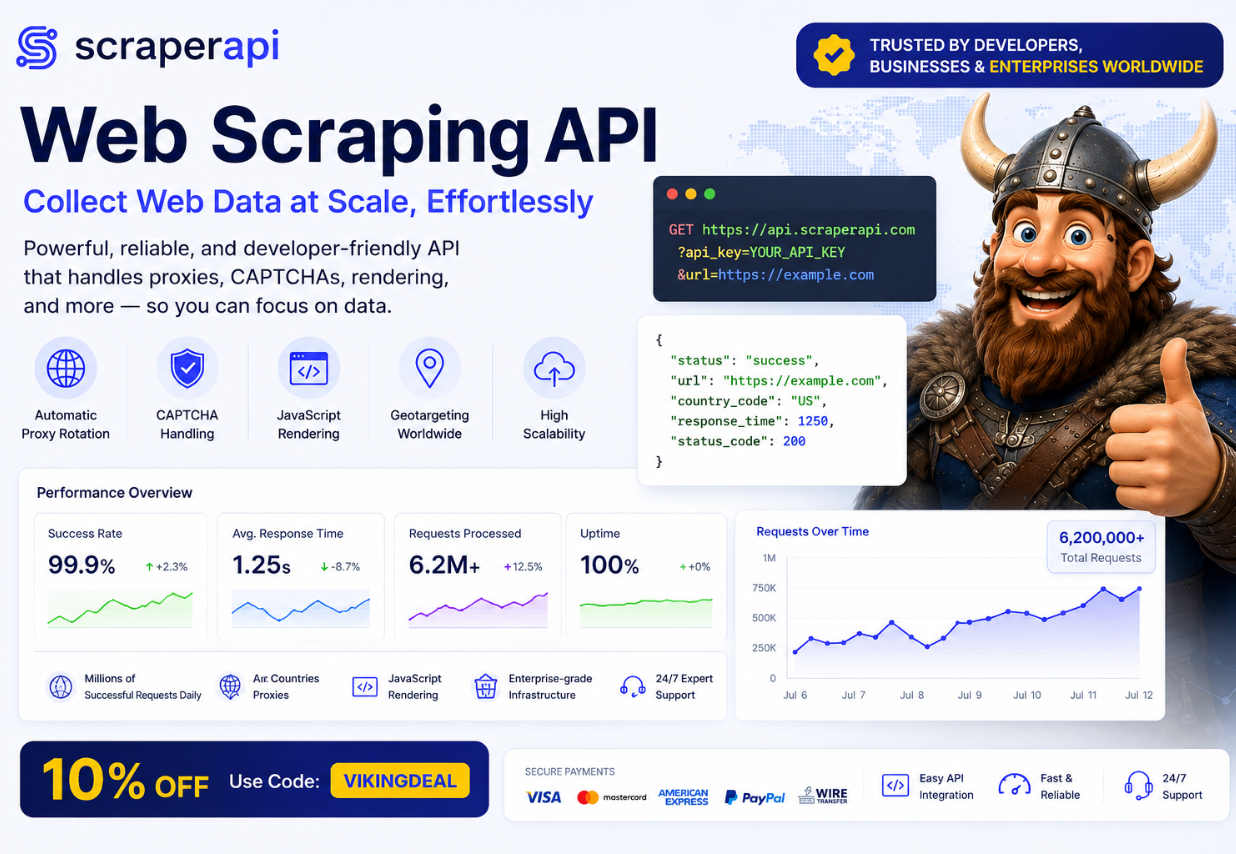
Most modern Web Scraping APIs include advanced capabilities such as:
- Automatic proxy rotation
- CAPTCHA handling
- JavaScript rendering
- Smart retry logic
- Geolocation support
- Browser emulation
- Scalable cloud infrastructure
These features significantly reduce the complexity of web scraping projects, allowing developers to focus on building applications rather than maintaining infrastructure.
As businesses increasingly depend on public web data, Web Scraping APIs have become an essential tool for startups, SaaS companies, SEO agencies, researchers, and enterprise organizations seeking reliable and scalable data collection solutions.
For example, a developer building a price monitoring tool can request product pages from multiple online stores through a Web Scraping API without worrying about IP bans or browser configuration. Similarly, an AI startup collecting publicly available data for machine learning can process thousands of requests while relying on the API provider to handle technical obstacles behind the scenes.
How Does a Web Scraping API Work?
Although the technology behind web scraping can be highly sophisticated, using a Web Scraping API is surprisingly straightforward. The service acts as an intermediary between your application and the target website, handling all the technical challenges that typically make large-scale scraping difficult.
A typical workflow looks like this:
- Your application sends a request containing the URL you want to scrape.
- The Web Scraping API routes the request through its proxy network.
- If the website uses JavaScript, the API can render the page in a real browser environment.
- If anti-bot protections such as CAPTCHAs or rate limits are encountered, the API attempts to handle them automatically.
- The platform retrieves the page content and returns the HTML or structured data to your application.
Instead of spending weeks building and maintaining scraping infrastructure, developers can often integrate a managed API in just a few hours.
Why Businesses Use Web Scraping APIs
As websites become more advanced, maintaining an in-house scraping system requires significant time, expertise, and ongoing maintenance. Managed Web Scraping APIs remove much of this complexity, making them an attractive option for businesses of all sizes.
Some of the biggest advantages include:
Automatic Proxy Rotation
One of the most common reasons scraping projects fail is IP blocking. Websites monitor incoming traffic and may temporarily block addresses that generate a high volume of automated requests.
A managed Web Scraping API automatically rotates requests through a network of IP addresses, reducing the likelihood of blocks and improving request success rates.
JavaScript Rendering
Many modern websites use frameworks such as React, Angular, or Vue to load content dynamically. A simple HTTP request often returns only a partial page because the actual content is generated after the page loads.
With JavaScript rendering enabled, the API loads the page in a browser environment before returning the fully rendered HTML, making it possible to scrape dynamic websites without building browser automation from scratch.
CAPTCHA Handling
CAPTCHAs are designed to distinguish human visitors from automated systems. Encountering them repeatedly can interrupt data collection and require manual intervention.
Many Web Scraping APIs automatically detect and solve supported CAPTCHA challenges, allowing scraping jobs to continue with minimal disruption.
Better Scalability
Whether you need to scrape a few hundred pages each week or millions of pages every month, cloud-based scraping platforms are designed to scale with your requirements. This flexibility allows businesses to expand their data collection efforts without rebuilding their infrastructure.
Key Benefits of Using a Web Scraping API
Choosing a managed scraping solution offers several practical advantages over building and maintaining your own scraping infrastructure.
| Benefit | Why It Matters |
|---|---|
| Faster Development | Launch scraping projects quickly without building proxy or browser systems. |
| Reduced Maintenance | The provider manages infrastructure updates and anti-bot techniques. |
| Improved Reliability | Automatic retries and proxy rotation increase success rates. |
| Global Coverage | Access localized content through requests originating from different countries. |
| Cost Efficiency | Eliminate the need to purchase and manage separate proxy services and browser automation tools. |
| Developer Friendly | Simple REST APIs make integration with most programming languages straightforward. |
For startups and growing businesses, these benefits can significantly reduce development time while allowing engineering teams to focus on building products instead of maintaining scraping infrastructure.
Common Use Cases
A Web Scraping API can support a wide variety of industries and business needs.
SEO & Search Engine Monitoring
SEO professionals use scraping tools to monitor keyword rankings, featured snippets, search advertisements, and competitor visibility across different locations.
Price Monitoring
Retailers and eCommerce businesses track competitor prices to adjust their own pricing strategies and stay competitive in fast-moving markets.
AI and Machine Learning
Artificial intelligence systems require large volumes of high-quality public data for training, analysis, and retrieval. Web Scraping APIs simplify the collection of these datasets while reducing infrastructure overhead.
Market Research
Businesses collect information about competitors, industry trends, product catalogs, and customer sentiment to make more informed strategic decisions.
Lead Generation
Sales teams often gather publicly available business information from company websites and online directories to identify potential customers more efficiently.
If you’re considering a managed solution, be sure to read our in-depth ScraperAPI Review, where we explore its features, pricing, real-world performance, and whether it’s the right choice for developers and businesses looking to simplify large-scale web scraping.
Challenges of Traditional Web Scraping
While web scraping offers tremendous value, building a reliable scraping system from scratch is rarely as simple as writing a few lines of code. As websites become more sophisticated, developers must overcome a growing number of technical obstacles that can quickly turn a simple project into a long-term maintenance challenge.
One of the biggest issues is IP blocking. Websites monitor incoming traffic and may temporarily or permanently block IP addresses that generate a high number of automated requests.
Another common challenge is CAPTCHA verification. These security checks are designed to distinguish between human visitors and bots. Without an automated solution, scraping workflows can stop unexpectedly and require manual intervention.
Modern websites also rely heavily on JavaScript frameworks such as React, Angular, and Vue. Instead of delivering complete HTML immediately, these websites generate content dynamically after the page loads. Traditional HTTP requests often fail to capture this information unless developers implement browser automation tools like Playwright or Puppeteer.
Other common challenges include:
- Browser fingerprinting
- Rate limiting
- Session and cookie management
- Frequent website layout changes
- Proxy management and replacement
- Retry logic for failed requests
- Infrastructure monitoring and maintenance
Maintaining all these components internally can consume significant engineering resources, especially for organizations running large-scale data collection projects.
Managed Web Scraping API vs Traditional Scraping
Before choosing a solution, it’s important to understand the differences between building your own scraping infrastructure and using a managed Web Scraping API.
| Feature | Traditional Scraping | Managed Web Scraping API |
|---|---|---|
| Initial Setup | Complex | Quick and simple |
| Proxy Management | Manual | Automatic |
| CAPTCHA Handling | Requires additional services | Built-in support |
| JavaScript Rendering | Requires browser automation | Usually included |
| Infrastructure Maintenance | Continuous | Managed by the provider |
| Scalability | Depends on your servers | Cloud-based and highly scalable |
| Development Time | High | Low |
| Reliability | Varies by implementation | Generally more consistent |
For small experimental projects, building a custom scraper may be sufficient. However, businesses that depend on continuous, large-scale data collection often benefit from managed APIs because they reduce maintenance costs and improve long-term reliability.
Best Web Scraping APIs in 2026
Several providers offer managed web scraping solutions, each targeting different types of users and business requirements.
ScraperAPI
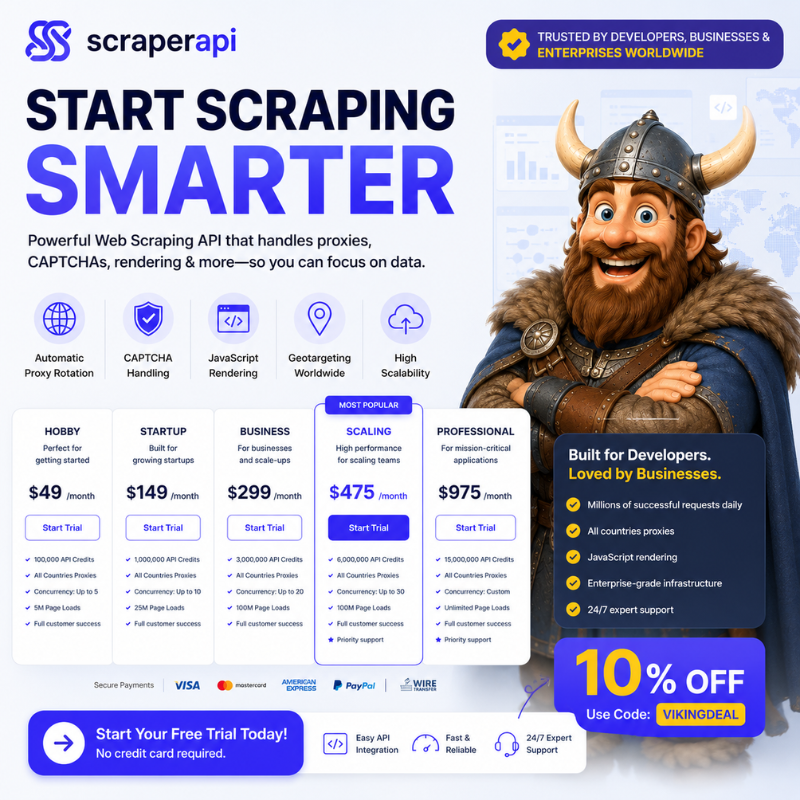
ScraperAPI focuses on simplicity and developer experience. It automatically manages proxy rotation, JavaScript rendering, CAPTCHA handling, retries, and geotargeting through a single REST API, making it an excellent choice for startups, SaaS companies, SEO professionals, AI developers, and businesses that want to deploy scraping projects quickly.
If you’d like a detailed analysis of its features, pricing, advantages, and real-world use cases, check out our comprehensive ScraperAPI Review.
Bright Data
Bright Data is one of the most comprehensive enterprise-level data collection platforms available. It provides advanced proxy networks, browser automation, and large-scale data collection tools. While extremely powerful, it may require a steeper learning curve and is often better suited for organizations with complex scraping requirements.
Oxylabs
Oxylabs offers enterprise-grade proxy services and data extraction solutions designed for organizations that need reliable large-scale web data collection. It is widely used by corporations requiring high performance and extensive geographic coverage.
ZenRows
ZenRows combines proxy rotation, browser rendering, and anti-bot bypass techniques into a developer-friendly platform. It is particularly attractive for developers seeking an easy-to-integrate solution with modern scraping capabilities.
Which Solution Is Right for You?
The best choice depends on your project goals, technical expertise, and expected request volume.
| Solution | Best For |
|---|---|
| ScraperAPI | Developers, startups, SaaS companies, SEO agencies, AI projects |
| Bright Data | Large enterprises requiring advanced data collection capabilities |
| Oxylabs | Organizations operating large-scale proxy and scraping infrastructure |
| ZenRows | Developers seeking a modern, easy-to-use scraping platform |
Rather than looking for a single “best” provider, consider which platform aligns with your technical needs, budget, and long-term scalability. A solution that works well for a solo developer may differ from what an enterprise organization requires.
The good news is that most leading providers offer documentation and trial options, allowing you to evaluate their features before committing to a long-term plan.
Frequently Asked Questions
Is web scraping legal?
Web scraping itself is not inherently illegal, but its legality depends on several factors, including the type of data being collected, how it is used, and the laws and regulations in your jurisdiction. Always respect a website’s Terms of Service and robots.txt where applicable, and avoid collecting private or protected information.
Do I need programming experience to use a Web Scraping API?
Basic programming knowledge is helpful, but many modern Web Scraping APIs provide simple REST endpoints, detailed documentation, and code examples in popular languages such as Python, JavaScript, PHP, Java, and Ruby, making them accessible even for beginners.
Can a Web Scraping API handle JavaScript websites?
Yes. Many managed scraping services offer browser rendering capabilities that load JavaScript-heavy websites before returning the fully rendered HTML or structured data.
Why do websites block web scrapers?
Websites often use anti-bot technologies to protect their infrastructure, reduce abuse, prevent excessive server load, and safeguard sensitive or proprietary content. These measures may include rate limiting, IP blocking, CAPTCHAs, and browser fingerprinting.
What’s the difference between a proxy service and a Web Scraping API?
A proxy service simply routes your requests through different IP addresses. A Web Scraping API goes much further by managing proxy rotation, browser rendering, retries, CAPTCHA handling, and other scraping-related challenges through a single interface.
Which Web Scraping API is best for beginners?
There is no universal answer, as the best choice depends on your needs. However, many developers prefer platforms that combine simple integration with features such as automatic proxy rotation, JavaScript rendering, and CAPTCHA handling. If you’re evaluating different options, our detailed ScraperAPI Review explains one of the most popular managed solutions available today.
Final Thoughts
Public web data has become one of the most valuable resources for businesses, developers, researchers, and AI applications. Whether you’re tracking competitor prices, monitoring search engine rankings, conducting market research, or building intelligent software, collecting reliable data efficiently is more important than ever.
While it’s possible to build a custom scraping infrastructure, maintaining proxies, handling CAPTCHAs, rendering JavaScript, and managing anti-bot protections can quickly become complex and expensive.
That’s why many organizations choose managed Web Scraping APIs. They simplify the entire process, allowing developers to focus on extracting valuable insights instead of maintaining infrastructure.
If you’re ready to explore a developer-friendly solution, we recommend reading our in-depth ScraperAPI Review, where we cover its features, pricing, advantages, limitations, and practical use cases to help you decide whether it’s the right fit for your next project.

VikingDeal curates the best real-time deals across the internet. We continuously monitor hundreds of online stores 24/7 to spot price drops, coupons, and limited-time offers.While our editors provide in-depth product analysis, this channel ensures you never miss a great deal.